
Vehicles
Carts, wagons, chariots, palanquins, galleys and ships are actors, like characters. Make one from the Actors tab: Create Actor → Vehicle.
The sheet
Section titled “The sheet”A header stays pinned at the top whatever you are looking at: the picture (click it to change it), the name, and tags for what matters right now — deployed, sinking, over capacity, short-handed — with the pace and how full the hold is. Under it are five tabs:
- Travel — the speed she makes now and why, the ground or the wind, the crew’s condition, the hull, and (at sea) the seamanship throws;
- Aboard — who is where: the seats, the crew complement, the team;
- Hold — how full she is and with what;
- Place — deploying her as a place, and whose goods are kept aboard;
- Details — what the book prints for her, and a description.
Setting one up
Section titled “Setting one up”A vehicle holds what its book prints and derives everything else. On Details, pick Land or Sea first — it decides what the other tabs offer: a wagon is pulled and driven, a ship is crewed, and offering either the other’s controls would teach you the wrong model. Then fill in her AC and structural hit points and her printed oar and sail speeds (a vessel), or her load and speed rows (a land vehicle). On Hold, type her cargo capacity in stone; on Aboard, the crew she wants or the team she is built for. Nothing you type says what is aboard — that comes from what you actually put aboard.
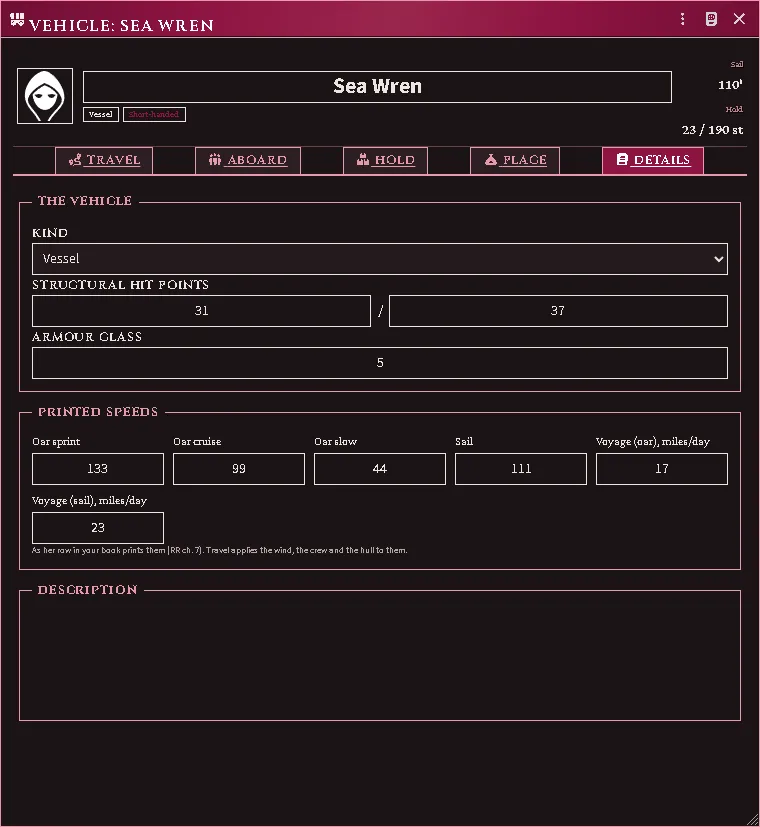
A galley’s Details: her kind, her hull and armour, and the speeds her book prints.
Stations, and loading it
Section titled “Stations, and loading it”Aboard is the vehicle at a glance: one group per seat she actually has —
the driver’s seat (or the whole printed complement, on a chariot or a howdah),
each crew role with its filled / required counter, the captain’s and
navigator’s chairs, the passengers, the team. Named people are chips; typed
counts are the unnamed complement and the two add up. Empty seats show as
dashed slots you can drop someone straight onto, and an empty officer’s chair
says what it is costing her. A crew member without the proficiency their seat
asks for wears an unqualified badge. Once your voyage tables are imported,
the group shows what its hands are effectively worth beside their head count
(RR ch. 7); until then it counts them in full and says so.
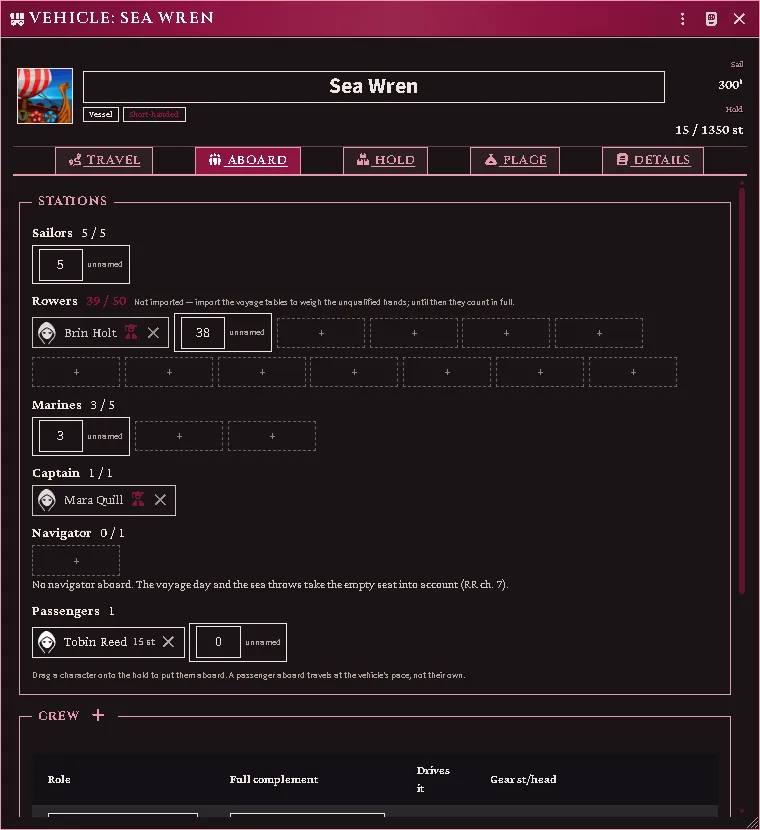
A galley short of rowers: the sailors at full strength, a named hand without the proficiency the seat asks for wearing the unqualified badge beside the unnamed complement; the marines are short, the captain’s chair is filled, the navigator’s is empty with what that costs, and one passenger is aboard.
Drag a character, an animal, another vehicle or an item onto the sheet. An actor drop asks what they are — passenger, a crew station, the team, or lashed on as cargo — with the cost of each choice stated before anything is written. A drop on a specific seat skips the question. An item dragged from another character’s sheet is moved into the hold; one from the sidebar or a compendium is copied in. Another vehicle can only ride as cargo.
The typed team rows remain for the ABSTRACT complement — “2 heavy horses” without minting two actor documents — and real and abstract pull add up.
What each role costs:
- a named passenger weighs what they actually weigh — body plus carried gear. An unnamed head costs the vehicle’s per-head rate, belongings included: that rate is the book’s generic traveller, not a floor under a real one. Leave the rate blank on Hold to use the one imported with the voyage tables, or type the vehicle’s own;
- crew and draft animals do not weigh against cargo at all — except that a non-motive crew’s gear (marines’ arms and armour) is freight, and the hold names that share;
- an actor carried as cargo — a canoe on the wagon — costs its full mass;
- a stack (a group actor — a merc platoon, a rower gang) counts every body it stands for, its chip marked with the count;
- passengers and cargo come out of one pool on every vehicle: a cart carries its riders on its bed, and a ship carries hers as cargo (RR ch. 4, ch. 7). A ship short of hands has their berths free for cargo, and the hold grows by them on its own.
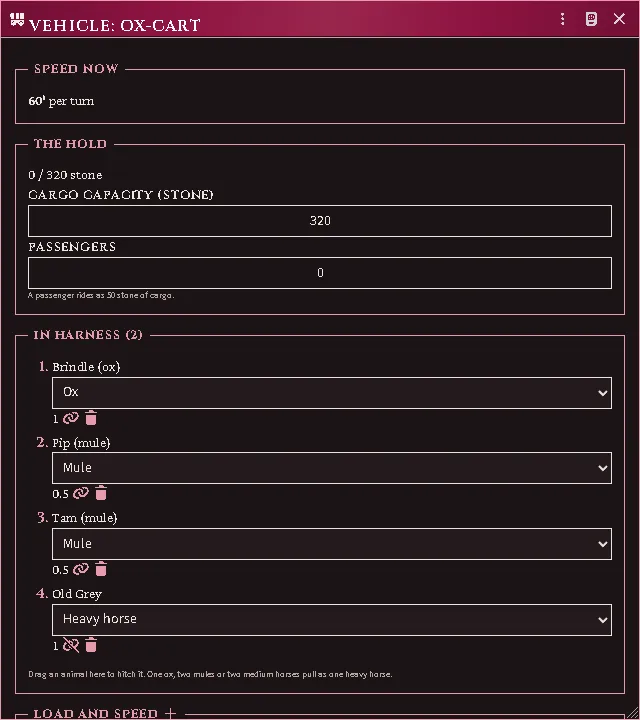
An ox and two mules pulling as two heavy horses, with one animal unhitched.
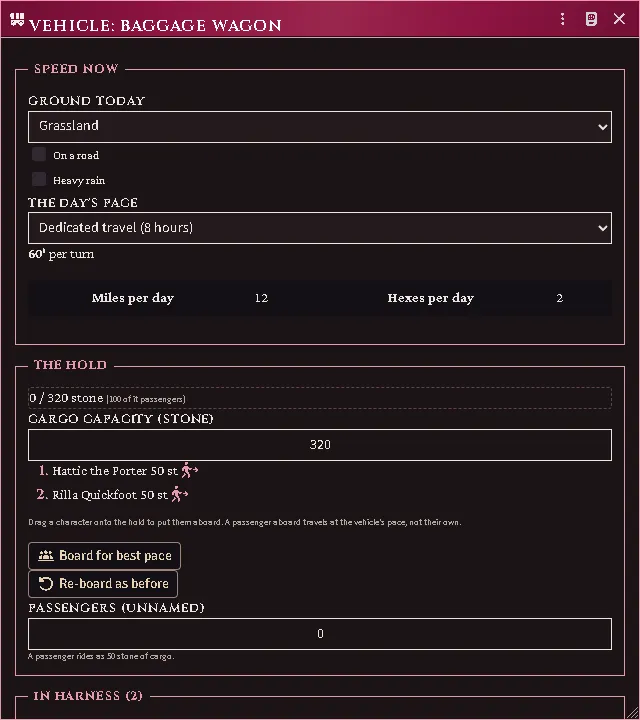
Two riders aboard, the day’s march in miles and hexes, and the boarding macros.
Board for best pace loads everyone the vehicle would carry faster than their own legs, slowest first, and stops when the hold is full. Re-board as before puts everyone back where the last change found them, which is what you want at a ford.
The hold
Section titled “The hold”Hold shows one bar — everything she carries against what she can carry — and what it is made of: freight, passengers, anything lashed on as cargo, and the marines’ gear. The same figure decides a wagon’s speed row, whether Board for best pace has room for one more, and whether a market will load a purchase into her, so a load is refused at the same line the bar turns red.
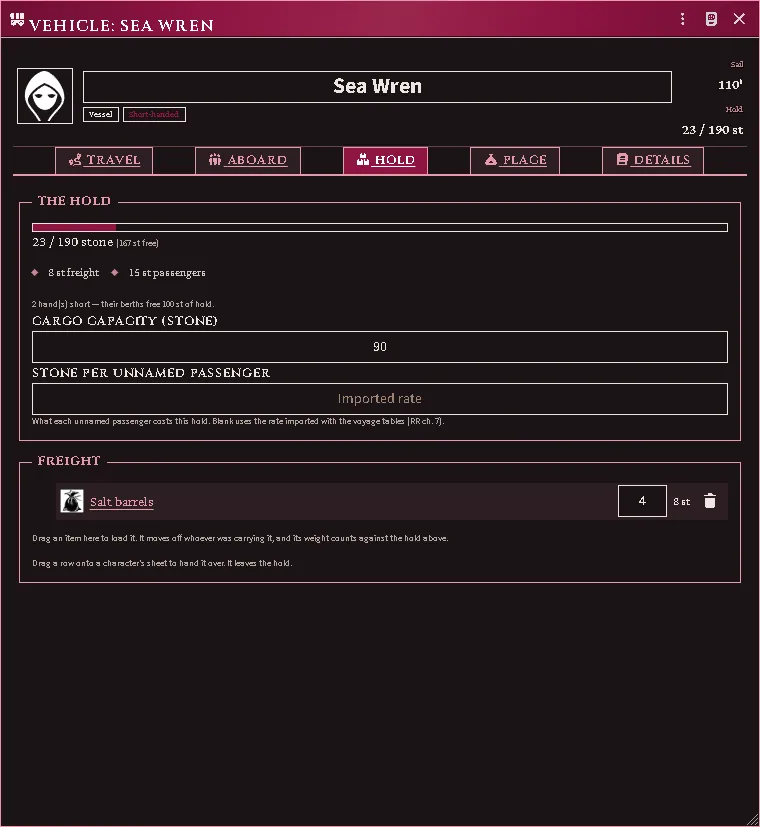
A galley’s hold: freight and a passenger against one capacity, grown by the berths of the two hands she is short.
The freight list tags trade goods bought at a market, and goods kept aboard for someone (see below). Change a quantity in place, unload a row, or drag it onto a character’s sheet to hand it over — it leaves the hold rather than being copied.
Deploying it as a place
Section titled “Deploying it as a place”Circle the wagons for the night, or tie the ship up at the quay: on Place, Deploy sets her down as a place in her own right.
- Her token stands beside the party as a point of interest on the map, walked to and stood beside like any place’s.
- Characters can keep goods aboard from their own Storage tabs, under whose they are; the Place tab lists them by owner.
- She is filed under a place — by default wherever the party stands (the town it is in, or the place the map belongs to) — or under one you choose, or none.
- Anyone aboard her is at her, whether or not she is on a map.
Strike takes the marker up and moves on; everything aboard stays aboard, and only what deploying did is undone — a token you placed yourself, or a place she was already filed under, stays as it was. The party’s train, on the formation sheet, has the same toggle beside each vehicle it brings. A player can deploy and strike a vehicle they own; the Judge’s client places the token for them.
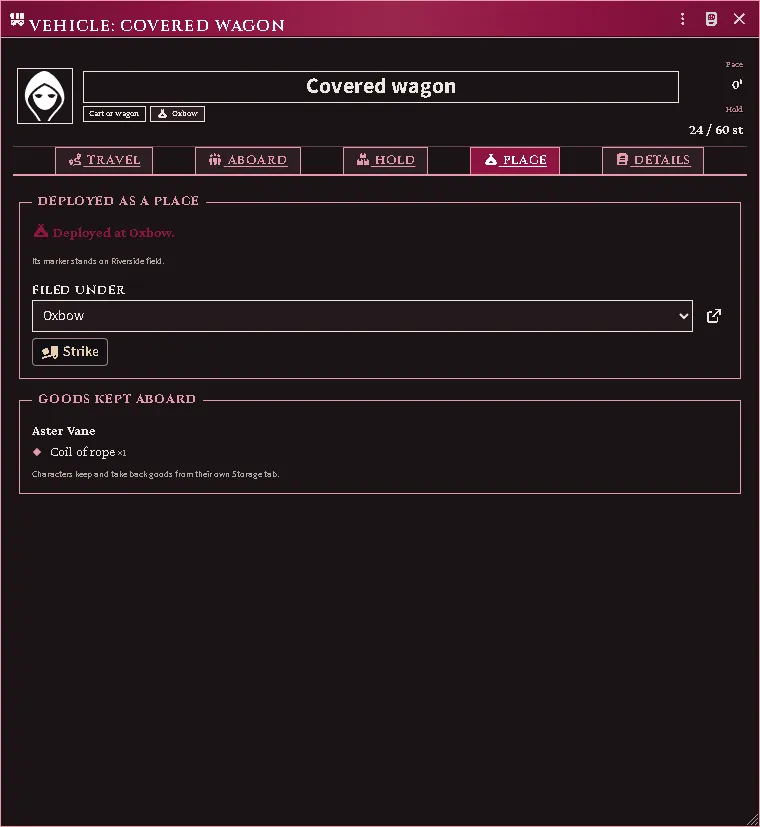
A wagon deployed at a camp: the map its marker stands on, the place it is filed under, and a coil of rope a trader keeps aboard.
Taking it to market
Section titled “Taking it to market”A party entering a market for a mercantile venture brings its transport, and the size of it is what the gate tolls and how much the party moves the market (RR §VIII.6). Enter the market lists your vehicles — one someone in the party rides is already ticked — and a number for anything else: porters, pack animals. Each vehicle counts at its hold’s capacity.
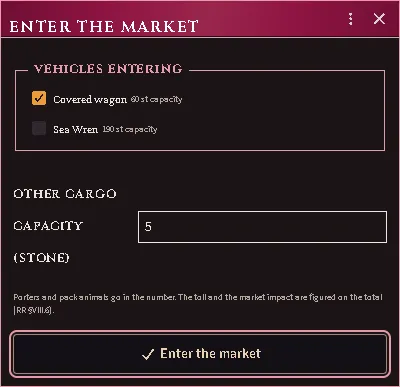
Entering with the wagon a trader rides already ticked, the galley offered beside it, and five stone of other cargo.
When you buy or sell a load, pick the hold: your own packs, or one of the vehicles you entered with, shown with its free room. A purchase too big for the vehicle’s free room is refused before any haggling; a sale takes its loads from that hold, across as many sacks as it needs. Goods someone else keeps aboard are theirs, and never sold for you.
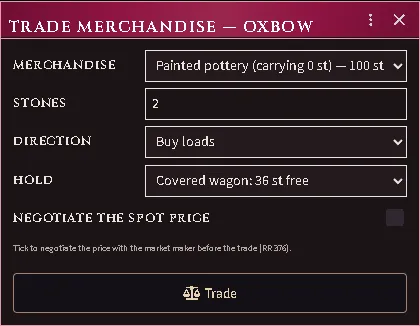
Buying two stone of pottery into the wagon, the hold picker showing the room it has left.
Mounts, and animals in harness
Section titled “Mounts, and animals in harness”A mount is an actor, not a piece of gear. Drop an animal from the Actors sidebar onto its rider’s character sheet and the two are bound, with a notice naming both: the rider moves at the mount’s pace, the party sheet shows a mount chip beside the rider, and the mounted-combat rules have something to read. You need to own both. A creature that is a monster rather than an animal is ridden by dropping it on the Mount line of the rider’s Equipment tab; dropped anywhere else on a character it is hired. That line names the mount, says what it is bearing, and takes you off it again (the character sheet).
Mounting moves none of your kit. While you ride, anything you drag between your sheet and your mount’s is moved rather than copied, so a pack dragged onto the horse comes off your own load. The mount bears you and everything you carry either way.
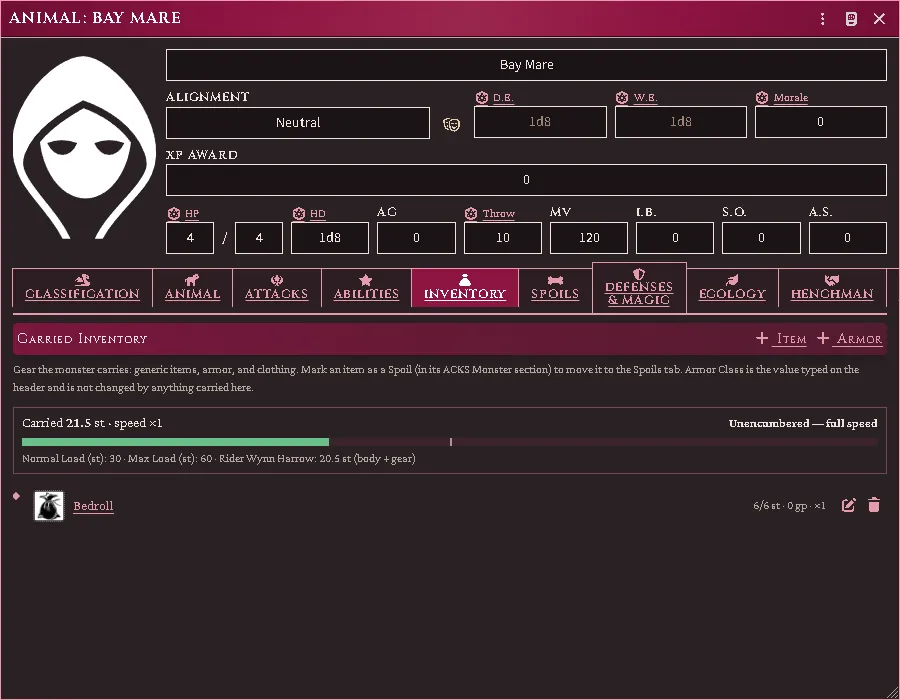
The mount’s own sheet after its rider dragged a bedroll onto it: the bedroll is in its inventory, and its load counts the rider and what the rider still carries.
Harness the same animal to a wagon instead and it joins the team; a rider on a horse that is itself in harness travels at the WAGON’s pace, because a carried thing resolves to whatever is really doing the moving.
A token that is not linked to its actor rides the same way: drop the animal on that token’s own sheet, and the mount counts the token as its rider.
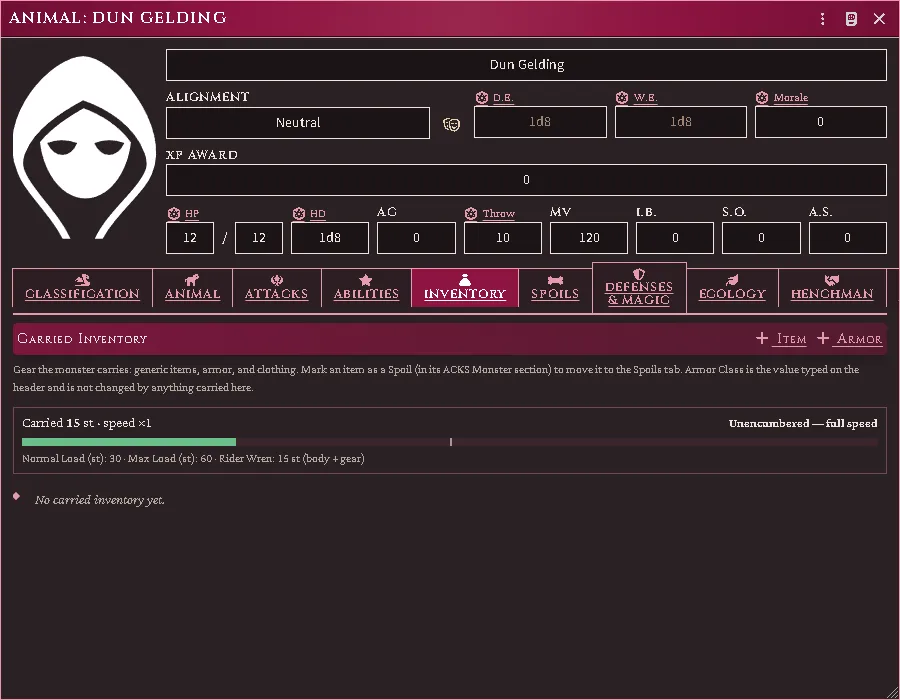
A mount ridden by an unlinked token: its Inventory counts the rider at body plus gear against the load the animal can bear.
With the mounted-combat overlay on, damage to a rider or its mount brings a card asking for the save the overlay reads (RR ch. 6). The card comes once, whichever seat dealt the damage, and it needs a Gamemaster connected.
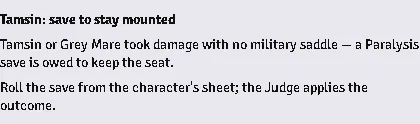
The card after a player lowered their own rider’s hit points on the sheet.
Two things about an animal decide what the rules do with it, and they are different questions. Its training — riding, draft, war, hunting, herding — is what it was schooled for, and the mounted-combat overlay reads it (RR ch. 6). Its mountability is whether the species can be ridden at all: an ox is rideable in principle and untrained in practice, and a war dog is trained for war and is still not a mount.
Both are filled by importing the animals from your own book. The rulebook prices animals by role — a Heavy War horse, a Draft mule, a Riding camel — so the importer reads the training out of the name the page printed, and treats a species the book sells in a riding form as one you can sit on. If you create an animal by hand instead, set them yourself on its sheet; an animal that has never said arrives untrained, which the rules read as “not stated” rather than as a claim, and fall back to its name.
A team is counted in heavy-horse equivalents. The heavy horse is the unit, so it always counts as one; what an ox or a mule is worth against it is a number your book prints, and it arrives with the travel tables. Until you import them, a team of heavy horses still adds up and anything else is shown as unpriced rather than quietly counted as nothing.
Making it move
Section titled “Making it move”Travel always shows the speed the vehicle actually makes, with a list of what reduced it — short crew, a heavy load, a hungry crew, a stowed mast, the wind, the ground. Change the wind or the terrain selector to see the answer change; those are your view of the moment, not properties of the vehicle.
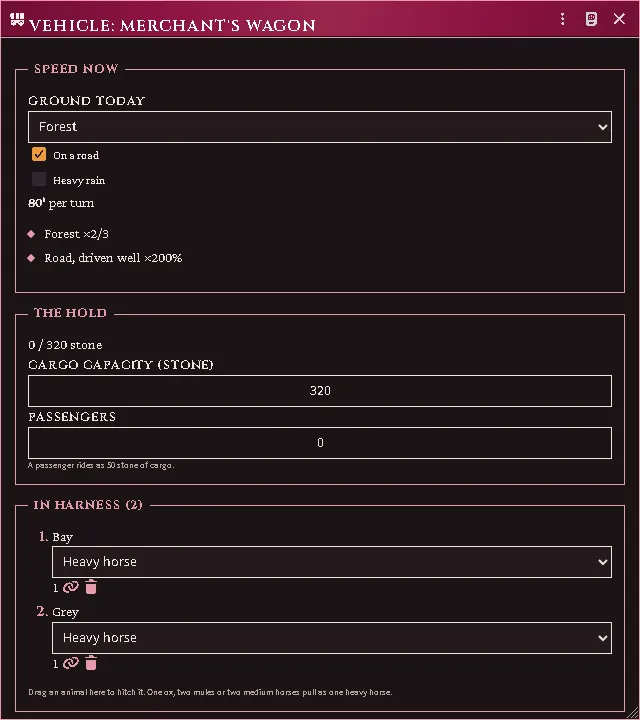
A wagon on a forest road, and what the terrain and the driver each did to its pace.
A wagon on ground that wheels cannot enter without a road is stopped, not slow, and says so.
A ship’s day is not a party’s day
Section titled “A ship’s day is not a party’s day”A voyage day and a march day are not the same length (RR ch. 7), so a ship’s miles a day and a party’s are not two numbers you can compare. Travel prints the hours in her day and her miles per hour beside the miles; compare those.
Damage, and what it costs
Section titled “Damage, and what it costs”Her hull is her structural hit points on Details: what she has left, beside what she has when whole. Travel draws the hull as a bar, and once she has taken damage it says two things under it:
- whether her damage or her missing hands is governing her speed, and what the other would allow — so you do not patch a hull to fix a speed the empty benches were costing;
- what a repair takes with the hands actually aboard: how much can be put back at sea, how much waits for a dock, and how many turns the work runs, at your book’s rates (RR ch. 7).
At nothing left she is holed through: Start the clock rolls how long she stays up, and Round passes counts it down.
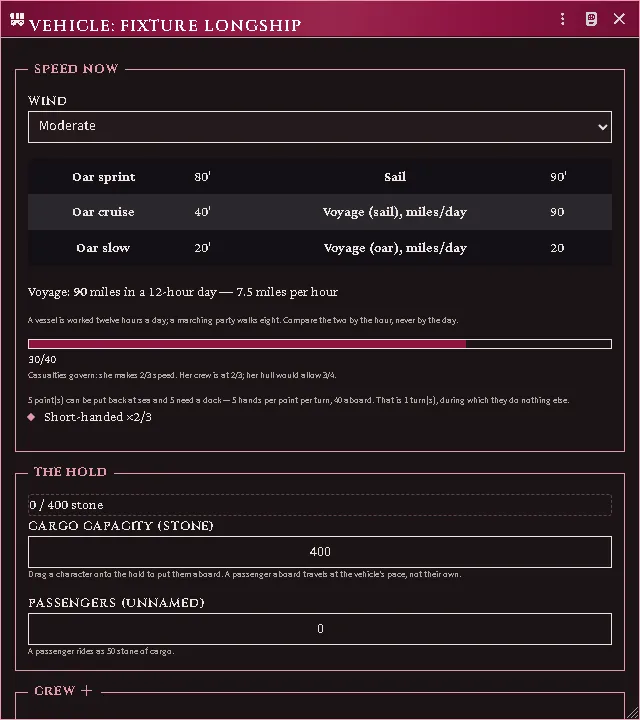
A holed longship: her hull, her voyage day beside its hour, which of casualties and damage governs her speed, and what a repair would cost.
Which attacks can harm a hull, and how much of a hit lands, is your book’s to
say (RR ch. 7). A macro can ask acksExtras.vehicles.damageToVessel(amount, source) what a hit does to her at your imported shares; type the result into
her hull.
Getting lost, and getting holed
Section titled “Getting lost, and getting holed”At sea, Travel carries two throws (RR ch. 7):
- Navigation throw — keeping her on course. The dialog asks which waters she is in, and prefills whether anyone aboard has Pathfinding or Navigation.
- Hazard throw — the captain’s, on entering water that holds a hazard. The dialog asks which hazard, prefills whether a master mariner has the helm, and asks about her speed and her draft; on a failure it states what that hazard does to her, from your imported tables.
Both dialogs list the throw’s parts before anything is rolled and whisper the result to the Judge. The prefills are a reading of who is aboard, and you can change them.
Every feature here is free and none of it is gated. If it earns its keep at your table, you can chip in on Patreon.