
Influence and reactions
A social roll with its whole modifier stack visible before you commit to it — who is rolling, against whom, in what tone, and exactly what is adding to the number.
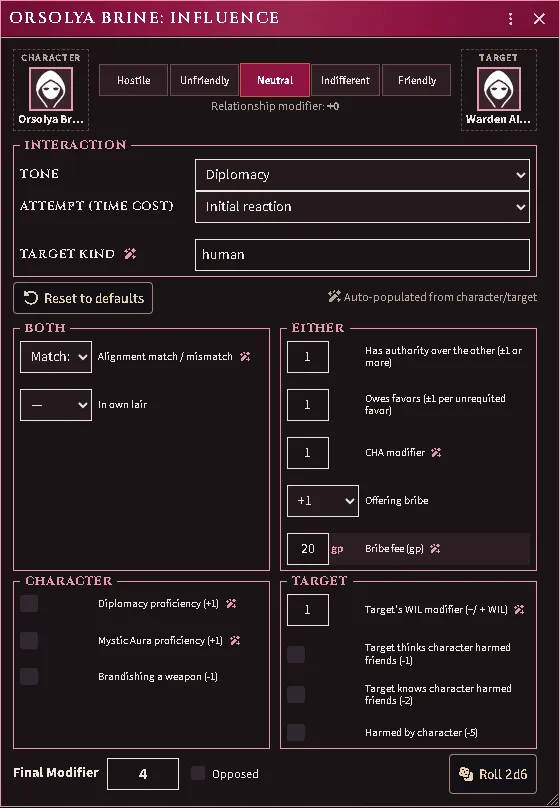
A social roll with its modifier stack itemized — here with a bribe armed and its fee typed, which only moves gold the payer actually has.
A bribe is paid in the payer’s own coin, drawn in the order their sheet states (where coin is paid from). A target who is an actor receives those coins, whoever runs them: where the roller’s seat cannot write to the target, the Judge’s seat hands the coin over. With no target actor, or with no Judge connected to hand it over, the bribe is paid off-stage and the coin is gone. A payer who cannot cover the fee is told so and pays nothing.
The result card says what was paid — the fee, who paid it, and who received it where somebody did. A card with no bribe line is a roll on which no coin moved. Where the roller has no Bribery proficiency, the card adds a line marking that the bribe carries a risk, with the page that says what (RR 287).
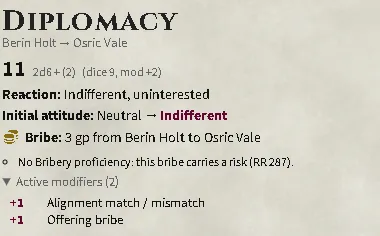
A result card after a bribe: the fee, the payer and the target who received it, the line marking the risk, and the modifiers that were in force.
Make a roll
Section titled “Make a roll”Select a character → Influence (actor context menu, or the API). Pick a target actor if there is one, and a tone.
The dialog fills in what it can detect: alignment relationship, level gap, age,
relevant proficiencies. Everything else defaults to neutral — false for
checks, 0 for values.
Modifiers come in three kinds:
- auto — detected from the two actors, pre-filled;
- effect-granted — contributed by an Active Effect, at its declared default;
- manual — yours to set.
Situational modifiers are toggles, not silent additions. The roll is offered, never asserted: you decide what is really in play, and the module does not decide for you.
A proficiency is offered only to a character who holds it. Diplomacy, Intimidation, Seduction and Mystic Aura draw a box on the hiring and market assessment pages only for a character holding that proficiency, or a power standing in for it, at the value on that character’s own item. One with no imported value is a field to type, with a badge saying so.
Attitudes
Section titled “Attitudes”An attitude item records how somebody feels about somebody else. Roll results can move it, and the current attitude feeds later rolls.
Effects that grant reactions
Section titled “Effects that grant reactions”Any Active Effect keyed flags.acks-extras.reaction contributes, with its own
situational / tone / label flags controlling how it presents.
This is shared with hiring: a reaction effect written here also feeds henchmen recruitment throws, so it is written once.
The hosted hiring, obedience and loyalty pages also count the employer’s henchmen powers: the obedience page adds the employer’s morale powers, the hiring page its hiring effects, and the loyalty page its loyalty-roll effects. A power held with no imported value is named in a note on the hiring and obedience pages.
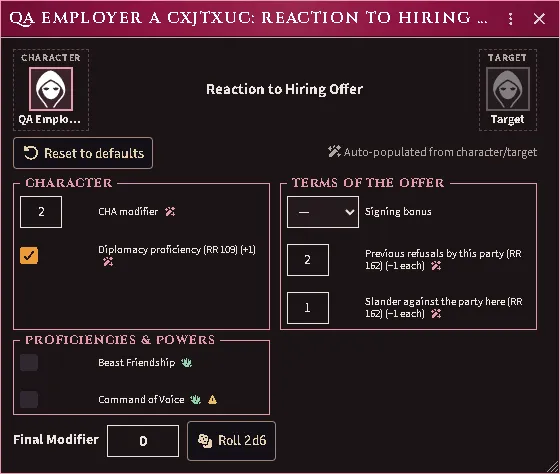
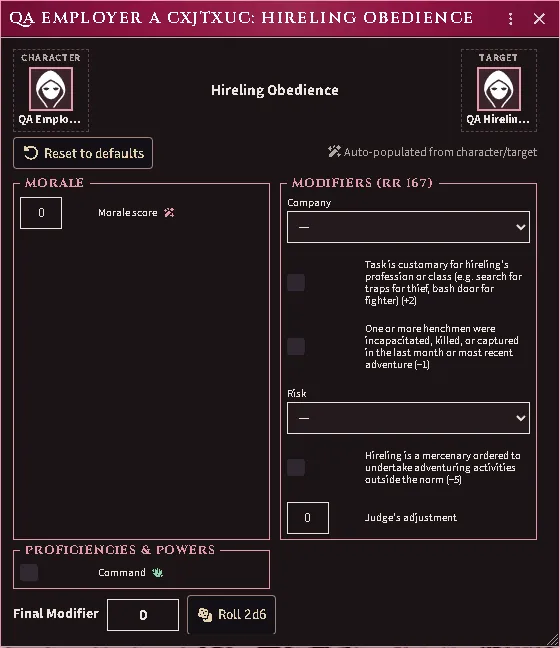
An ability is counted once per page. Where the page already offers a proficiency as its own checkbox — Diplomacy, Intimidation, Seduction, Mystic Aura, and Performance on a seduction — that checkbox is the ability’s whole contribution, and its effects add no second row. An ability the page has no checkbox for gets a row under Proficiencies & Powers.
A class power can stand in for one of those proficiencies: give its effect
flags.acks-extras.actsAs naming the proficiency (diplomacy, intimidation,
seduction, mysticAura) and it fills that checkbox under its own name. A
character who has the power and the proficiency gets the box once, under the
proficiency’s name — they are one capability, and the book does not stack it
with itself.
What the surroundings add
Section titled “What the surroundings add”Some rows are not yours to type. They come from where the party stands and who it is dealing with, and they sit read-only under their own heading.
- A quarter’s reception comes from the district the party is standing in (streets and quarters).
- Standing with … comes from a faction’s ledger: whoever controls the quarter, on every reaction roll made there, and — when the roller is opened with its target named — the faction being spoken to and any faction the other party belongs to (factions).
- Legal authority here is a note with no number beside it. It says the speaker belongs to the watch or the noble house that holds this quarter; the authority tick is still yours to set.
The social status row fills itself with how many ranks the speaker stands above the other party, when both have a rank (status).
Combat morale
Section titled “Combat morale”A sheet’s Morale button opens the Combat Morale page in place of the bare roll, and so does Roll Morale on a hired group’s entry in the Actors sidebar. Choose what applies from each list, tick what is true, add an adjustment of your own, and roll: the card lists every modifier by name with its figure, the dice and the total, and names the result (RR 307).
The lists and the results are your book’s. Until the rules tables are imported each modifier is a field you type into, and the card names no result (importing from your books).
The page lists the creature’s conditions under their own heading. One that changes the roll is a row in the total and on the card; one whose figure this world has not imported is a note with nothing added; and one under which the creature makes no morale roll says so.
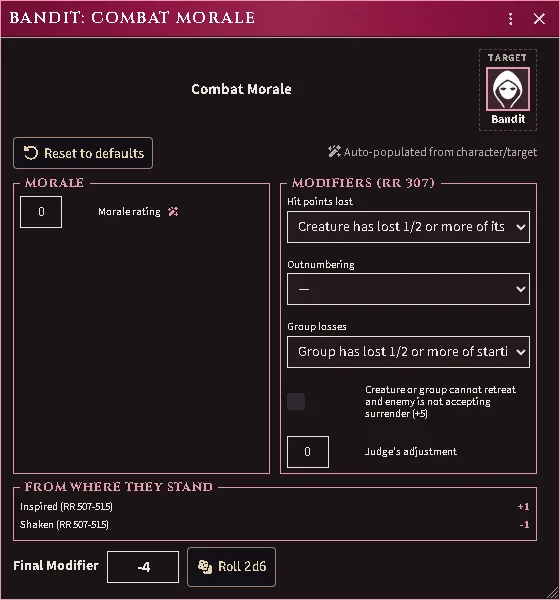
The Combat Morale page for a monster carrying two conditions: two modifiers chosen from the imported lists, each condition a row of its own beneath them, and the final modifier beside the roll.
For the system’s plain roll, hold the skip-dialog key, or turn off the world setting Morale rolls open the modifier page.
Badged rows
Section titled “Badged rows”A row marked unaudited (amber, not red) is a mechanic that has not been read against the printed page. It is probably right and is genuinely offered — it is just not asserted as the book’s ruling. Treat it as a suggestion until you have checked it.
Common problems
Section titled “Common problems”A modifier shows as “undetermined”. A value it needs could not be resolved — usually a level or scale that is not set on the actor. It is skipped rather than counted as zero, because an unknown is not a modifier.
An effect I wrote isn’t appearing. Check the change key is exactly
flags.acks-extras.reaction — membership is tested exactly, not by prefix, so a
near-miss contributes nothing.
Nothing auto-populated. Both actors need the underlying data (alignment,
level). With one side missing, most auto sources have nothing to read.
Every feature here is free and none of it is gated. If it earns its keep at your table, you can chip in on Patreon.