
Places, storage and markets
A place is anything that holds things: a duchy, a town, an inn, its cellar, and the chest in the cellar. They nest, they hold goods and living things, and some of them have a recruitment market. One actor type covers all of it.
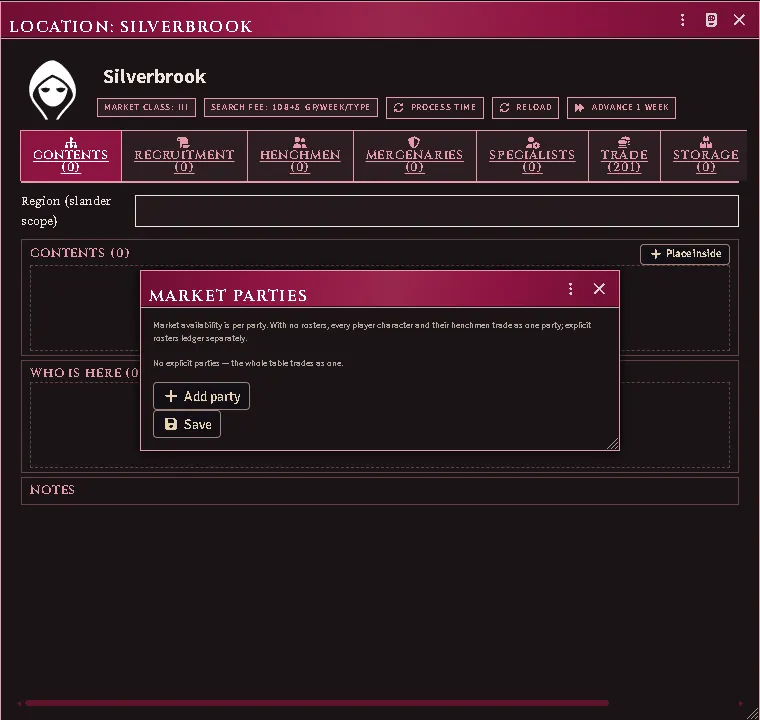
A place that holds goods, and who is recorded there.
Make a place
Section titled “Make a place”Actors sidebar → Create Actor → type Location.
A new place opens on the Contents tab with nothing but a name. That is the whole of the minimum: identity, and what it sits inside.
- Parent — the place this one is in. Set it and a breadcrumb appears (Duchy of Harrowmere › Rusty Anchor › cellar).
- Stack count — for eight identical warehouse bays, keep one actor and set the count to 8. Split one off when it becomes interesting.
- Roster — the living things kept here: a garrison, a stabled horse, a captive. These are references to real actors, so a deleted actor leaves a struck-through row rather than vanishing.
A place a domain holds names that domain beneath who is here. A place inside a held one names the domain that holds the place around it. Which places a domain holds is kept on the domain’s own sheet (Holdings).
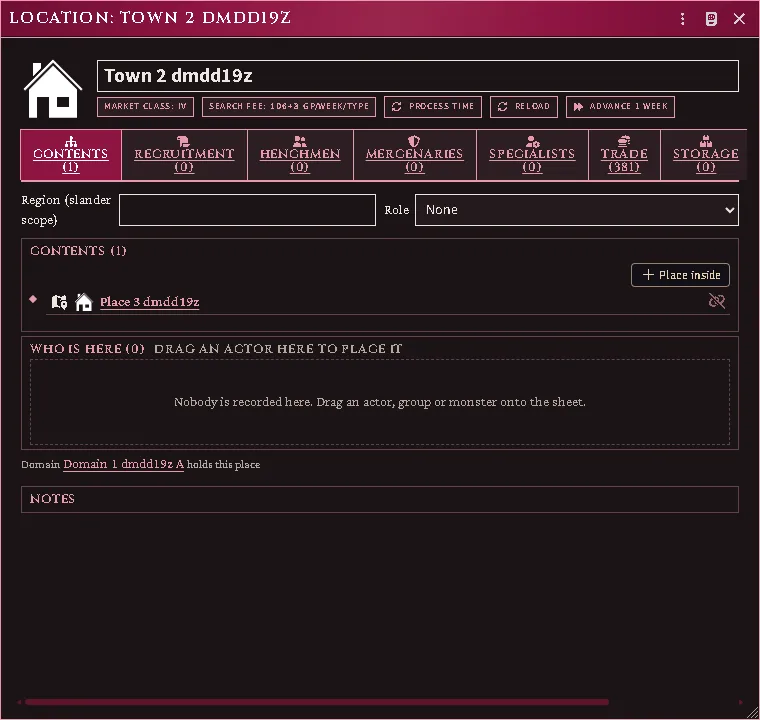
A town a domain holds, naming the domain on its Contents tab.
A place also keeps a private record beside its shared one, which only the Judge can read.
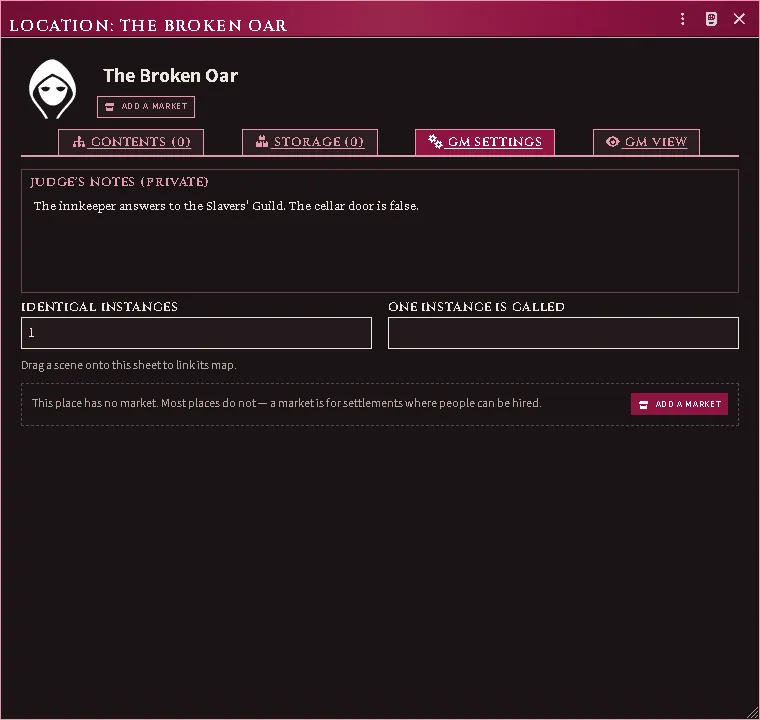
A place’s private record, beside the shared one and readable only by the Judge.
If the place is a map you already have, link it: Scene config → Location, or right-click the scene in the sidebar. The link is never made automatically — most scenes are battle maps and lighting tests, and forty auto-created actors on first load is not a favour.
A place can also stand ON a map: drop the actor on any scene and its token is a point of interest — a marker with its name on hover and no bars, which the formation guide’s Points of interest section walks. A quarter drawn as a district can name a place as its own from the district’s sheet.
Mark a place’s role
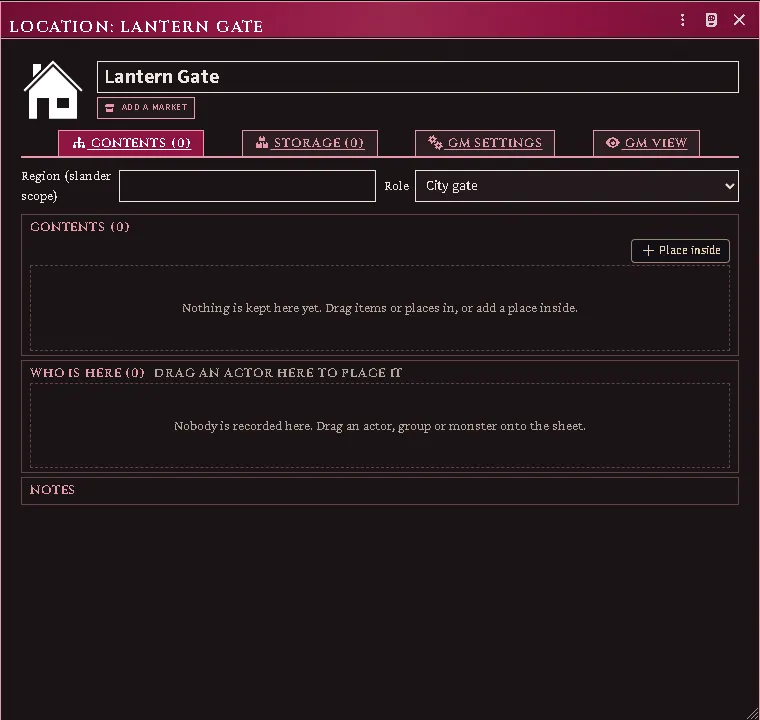
Section titled “Mark a place’s role”Some places have a Role — today, marking one as a gate. Pick it on the identity line under Role. The Judge sees the picker; players see a tag instead. The points-of-interest step of a settlement import marks a book’s gates for you, on a fresh import and on places a world already holds. Nothing reads the marking yet; the gate action that will is a future release.
Store goods there
Section titled “Store goods there”Drag an item onto the sheet’s Storage tab, or use Deposit here.
Drag it from a character’s sheet, not from the Items sidebar. Goods are filed under whose they are, and an item in the sidebar or a compendium belongs to nobody yet — there is no owner to file it under, so that drop is refused with a notice rather than landing unattributed. To put a hoard into play, give it to a character first (or to the party’s pack mule) and stow it from there.
Goods are grouped by whose they are, because a warehouse holding three characters’ gear is three inventories in one actor, not a shared pile. Each character sees a Retrieve button on their own rows; the GM sees it on all of them. A player does not have to own the place to leave goods there or take their own back.
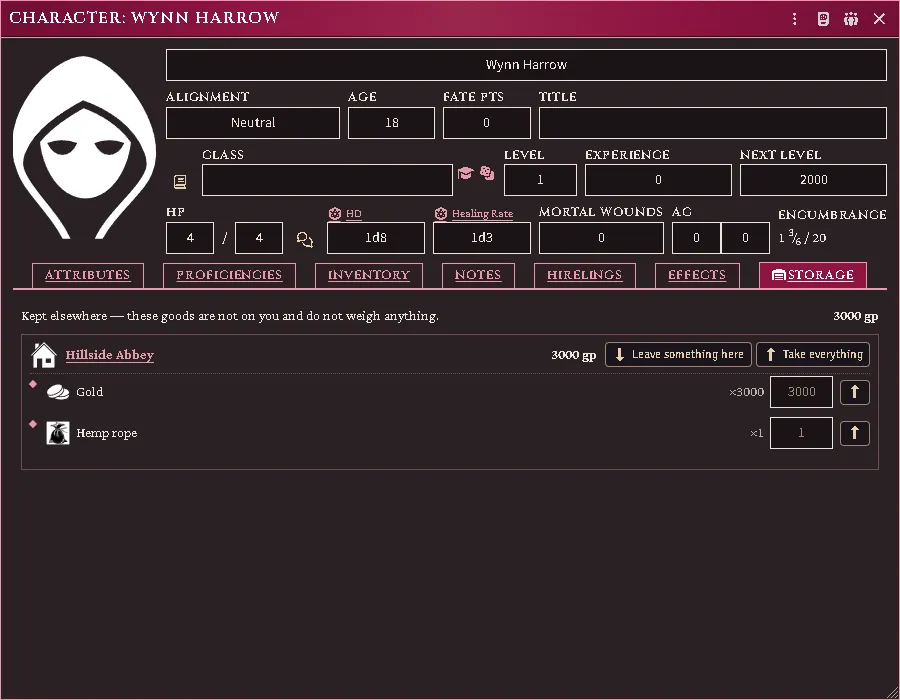
A player’s seat, on the Storage tab of the system’s character sheet: coin and a rope kept at a place the Judge runs, with the controls to leave more and to take it back.
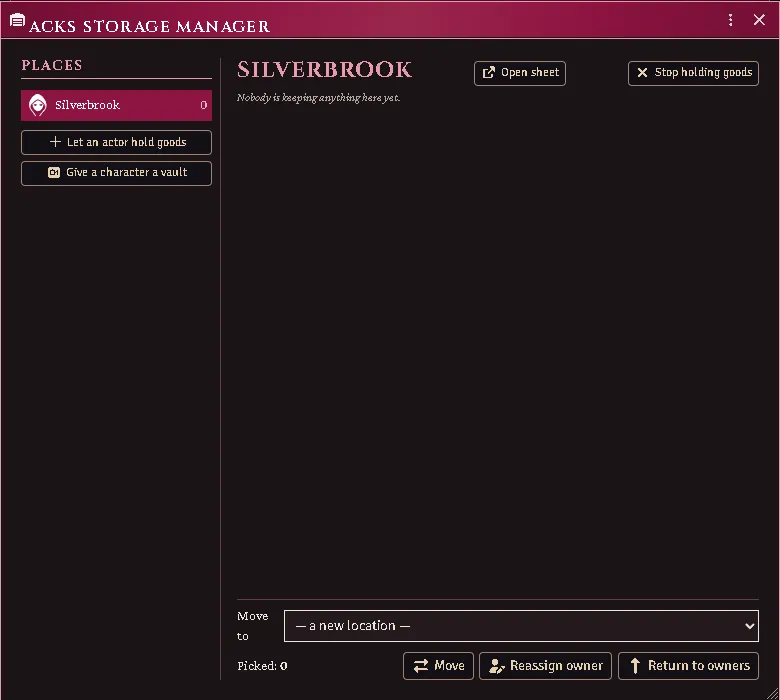
Moving goods in and out of a place that holds them, and giving a character a vault.
One of those piles is the house — what the place itself owns rather than what somebody left there. The Judge can lock a row so it cannot be taken, and a spoil that has not been valued yet sits there awaiting its throw.
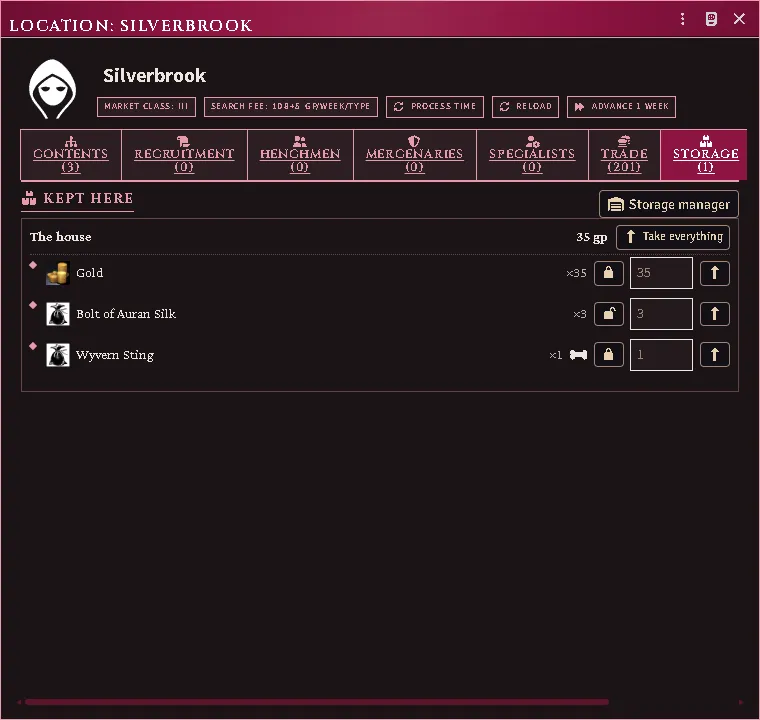
A location’s own coin and stock: the Judge’s locks, and a spoil awaiting its throw.
Stored goods are real items on the location actor, so an item that has left a character genuinely stops weighing on them. Stowing is a move, not a copy: the item leaves the character. Dragging between two ordinary character sheets is the system’s own copy, which is why a plain “treasure actor” leaves the original behind — a place is the surface built to hand goods over without duplicating them.
Attribution is a UI convention, not a security boundary. Anything that must genuinely stay private belongs on a GM-owned actor.
Deleting a place returns its goods by default — each owner gets a container
named after the place. The GM setting storageDeletePolicy can change that to
“lose”, for the campaign where a sacked city takes your warehouse with it.
Coin stows like anything else you carry: drag a coin row onto a place or into a pouch, or pick it in Deposit here. To leave part of a purse, divide the stack first (the character sheet) and stow the pile.
There is no bank column any more, on any sheet. Coin that is safe is coin kept at a place. A balance an older world still holds there is moved out when the world next loads: a character’s into their vault, and anyone else’s (a monster, a hired unit, a token) into the coin they carry.
Paying with coin kept elsewhere
Section titled “Paying with coin kept elsewhere”Coin kept at a place is still yours to pay with. A payment draws on your stores in the order your sheet states (where coin is paid from), and coin that arrives can be sent to a place keeping coin for you.
How far that reaches is the Judge’s, in Configure Settings → Paying with coin kept elsewhere. It answers for every payment that does not itself say where it happens — a wage, a bribe, a fee:
- All of it, wherever it is kept — the default. A vault three days’ ride away pays as readily as a purse.
- Coin on hand, and coin kept on the scene the payer stands on — the strongroom of the town you are in counts; the one in the town you left does not.
- Coin on hand only — what you carry, and nothing else. Coin kept at a place has to be fetched before it can be spent.
Some transactions say where they happen, and the setting does not move them. What you buy, sell, import or commission at a market is paid with coin on hand or kept at that market, whatever the world’s setting (markets).

The world setting as the Judge sees it, at its default.
On the system’s own character sheet the Money header gains two lines: how much is kept for the character and at how many places, which opens the Storage tab, and the same Pay from and Receive into choices the module’s sheet offers.
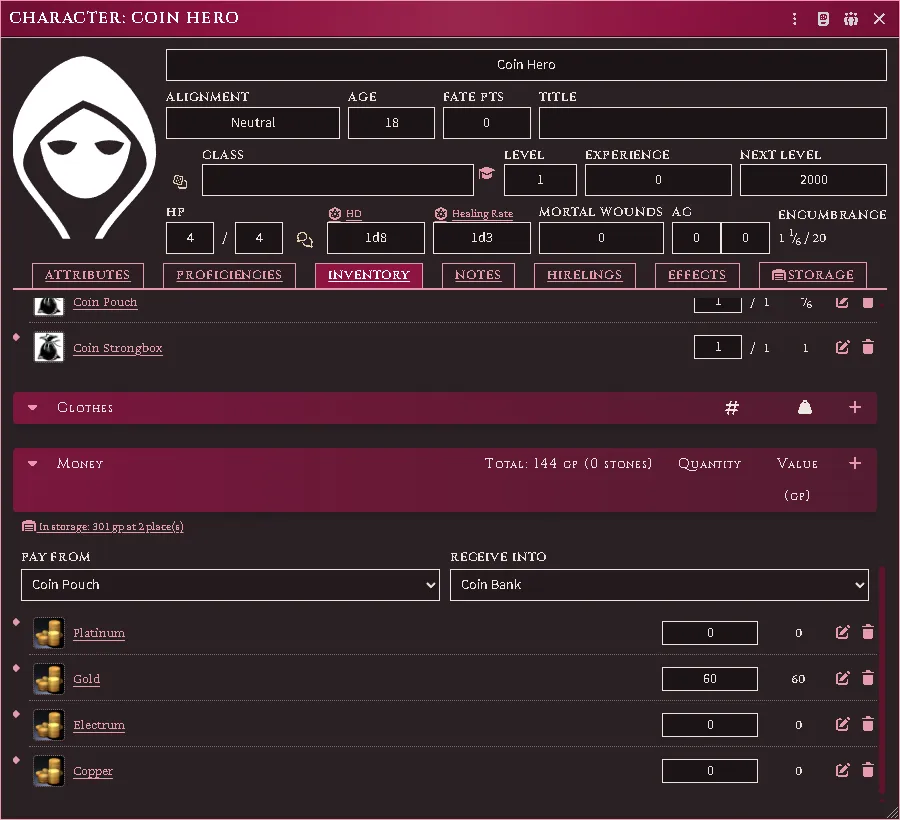
The system sheet’s Inventory tab: the coin kept elsewhere totalled under the Money header, and the two choices above the coin rows.
Be somewhere to leave something there
Section titled “Be somewhere to leave something there”A character’s own sheet lists the places their goods are, under Kept elsewhere on the Equipment tab, and each row says whether they can put something down there from where they are standing.
The list is deliberately short. It holds everywhere they actually keep something, whatever else is true of it, plus wherever they are standing right now, their own vault, and any place they have pinned. A world with a whole imported city in it holds dozens of places nobody has ever left anything at, and none of them belong on a character sheet — so owning a place, or marching with someone who owns it, does not put it on the list by itself. Pin it while you are there and it stays.
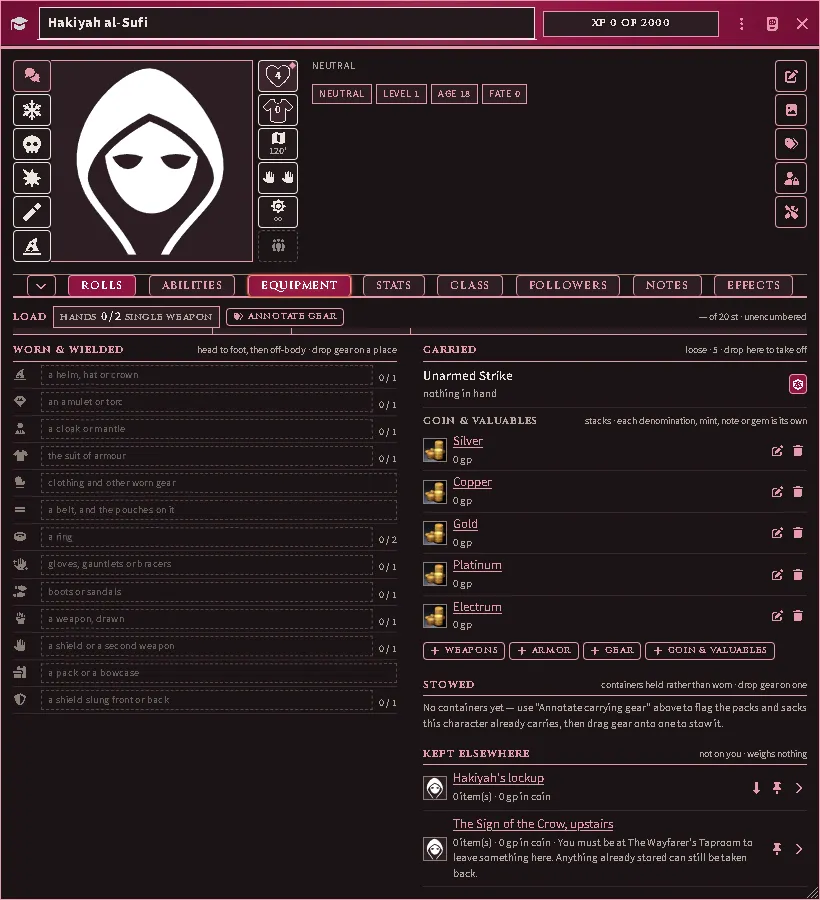
The lockup is a cart in the street beside them, so the deposit arrow is offered. The inn is a map they are not on, so the row names that map and offers no arrow — only the ways back out.
A place that is a map is reached by being on it, whether or not it is the map currently up on everyone’s screen. A place that is not a map — a cart, a shrine, a cellar — is reached by standing at its own token, or by a claim on it: your own vault, a place you hold, a place somebody you are marching with holds, or one you have pinned to your sheet by dragging it there. A character in a party has no token of their own, so the party’s token is where they are.
Taking things back is never gated. A character who has walked away from their own goods can still withdraw them from anywhere; it is only leaving something NEW that asks where you are standing.
Give a character a vault
Section titled “Give a character a vault”A vault is a place of one character’s own: only they and their players can reach it. You are given one automatically the first time a banked balance is swept out of the retired bank column, or an estate is settled on you.
That sweep only visits a character who still has a balance to move, so a vault that is deleted does not come back on its own — by then there is nothing left to sweep. Settings → Storage Manager → Give a character a vault makes one on demand.
This is not the same as Let an actor hold goods, which makes a shared place — a wagon, a stronghold, an inn — that anyone with access can reach.
Add a market
Section titled “Add a market”Most places have no market. GM Settings → Add market creates one, and four extra tabs appear.
Removing a market removes the data with it, not just the tabs.
A market can disagree with the book about who is common here. Under GM Settings, the rarity overrides take a class and a tier, one row each: a directed search for that class then rolls on the tier you picked, whatever the rarity table says. A university town where mages are easy to find is one row.
Who holds the town can matter too: see what standing does.
Common problems
Section titled “Common problems”The market tabs aren’t there. The place has no market. Add one from GM Settings — they are opt-in per place.
A roster row is struck through. Its actor was deleted. The row stays so you can act on it; remove it when you have.
The breadcrumb stops short. A parent points at a place you cannot see, or one in an unloaded compendium. The chain renders as far as it resolves.
Retrieve isn’t offered. The goods are attributed to a character you do not own. A GM can reassign attribution in the Storage Manager (Settings → Storage Manager).
“Nothing was moved.” The stack you picked is empty. A balance still in the retired bank column is not coin anyone carries — it is moved out at the next world load, a character’s into their vault.
“… carries no goods, so nothing can be handed to it.” The sheet you dropped something on lists no goods — an organisation, a party, or a hired unit for anything but coin — so nothing there could show it again. Nothing was moved or copied. Drop it on whoever is to carry it, or on a place.

The warning a rope dropped on an organisation’s sheet gives. The rope stays with whoever held it.
“A GM must be connected for that.” The payment, deposit or withdrawal touches a place your seat cannot write to, and the Judge’s seat carries those out. Nothing was taken; try again once the Judge is connected.
My character has no vault any more. Deleting one does not regenerate it. A GM makes a new one with Storage Manager → Give a character a vault.
My character has become a warehouse. Something turned storage on for them — most likely the Enable Storage Here macro run with their token selected. Open Storage Manager, pick them in the list, and use Stop holding goods; the Disable Storage Here macro does the same for a selected token. If anything is stored on them, return it to its owners first — the button is on that same screen. Clearing the flag moves nothing, so goods left behind would sit on an actor that no longer appears as a place to anyone.
A character can no longer be made a place by accident: the macro refuses one and points at Give a character a vault, which is the thing you almost certainly wanted. A place is somewhere goods are left; a character is who leaves them.
Every feature here is free and none of it is gated. If it earns its keep at your table, you can chip in on Patreon.