
Overland travel
A journey in ACKS II is a sequence of small, costly decisions — how fast to march, what to spend the day's spare hours on, whether the party can afford to stop. This is what the module makes of that: a day board you fill in, a march derived with every factor named, and a camp that keeps track of what the country and the weather are doing to the people in it.
Every figure behind these surfaces — each threshold, target, penalty, yield and rate — arrives through the importer from your own books. Until you have imported them the panel still works and says plainly what it cannot price. It never guesses a distance, a target or a toll.
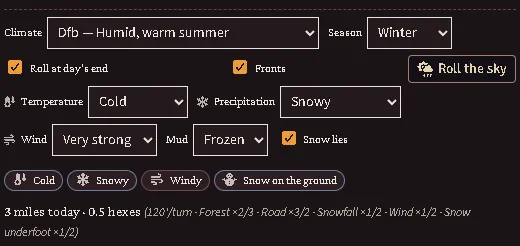
The sky, and what it costs
Weather is settled once a day for the ground you are standing on, derived from the date and the climate rather than stored on whoever happened to roll it — so two parties in the same country get the same day. The conditions it produces are named, and every one of them shows up in the march beneath: forest, a road, snowfall, wind and snow underfoot, each as its own factor. Mud and snow accumulate and dry out on their own.
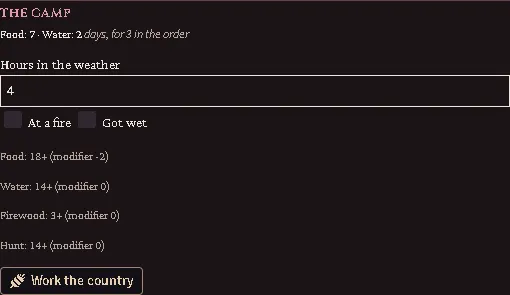
The camp
How many days the packs hold for everyone in the order, who is going short, and what tonight's chosen hours are worth. Food and water are pooled across the whole party and dealt by a policy you choose. The hours in the weather are yours to declare — a marching day is not automatically a day spent unprotected, so the module does not assume one.
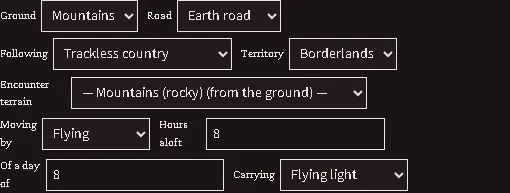
Flying, and what a flier skips
How the order moves decides which factors it meets at all. Pick flying and two more fields appear — how much of the day was spent aloft, and what the flier is carrying. A flier still meets the ground below it, ignores roads entirely, and feels wind by its own rule rather than the one that slows a walker. The readout names which factor replaced which.
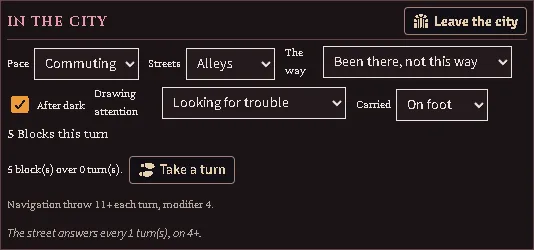
In the city
A settlement is crossed the way a wilderness is, at a different scale: a pace, the avenues or the alleys, how well the party knows the way, and whether it is dark. Take a turn and the party covers its blocks, tests its way, and the street gets its own chance at them. A party that goes looking for trouble finds it more easily — the throw eases, it does not come round sooner.
A day, end to end
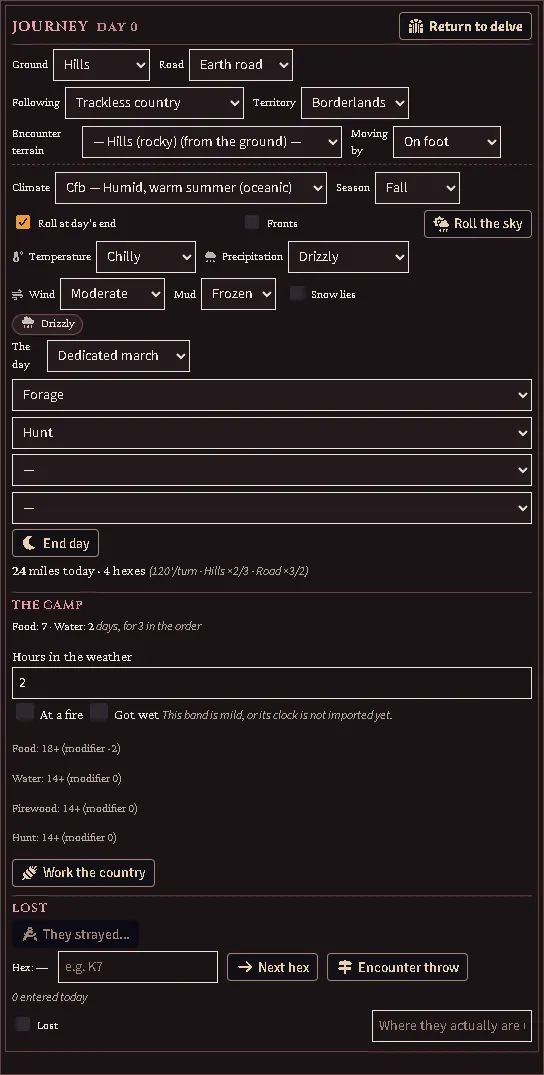
The whole Travel tab as a Judge sees it: the ground and the sky at the top, the day board and its four ancillary hours, the march with every factor named, the camp below, and the log of days already walked. End day throws for navigation, feeds the order, walks every body's hunger, thirst and exposure one step, and writes the day down.
Getting lost
The one surface with no screenshot, because the whole point is that the players cannot see it. A failed navigation throw is whispered to the Judge, not announced. The party walks on believing it is somewhere it is not, and the map fills in with the ground they think they crossed — while the Judge alone watches a hidden marker move across the country they are really in.
When they realise, that imagined ground closes back over and they are told, in as many words, that the last few days were not where they thought. They do not learn where they went. Finding their way back to a known landmark is what puts the country they really crossed onto the map, in its right place.
The formation guide explains how to drive all of this, step by step.
Every feature here is free and none of it is gated. If it earns its keep at your table, you can chip in on Patreon.